沉积岩型层状铜矿床成矿年代学研究进展及展望
doi: 10.20008/j.kckc.202508013
赵路通 , 刘建明
中色紫金地质勘查(北京)有限责任公司,北京 100012
基金项目: 本文受国家“305”科研项目(2015BAB05B04-03)、国土资源部行业基金项目(201511016-02)和紫金矿业集团矿山综合找矿预测专项(4104KY2022030001)联合资助
Research progresses and prospect in the geochronology of sediment-hosted stratiform copper deposits
ZHAO Lutong , LIU Jianming
Sino-Zijin Resources Ltd, Zijin Mining, Beijing 100012 , China
摘要
沉积岩型层状铜矿床(SSC)是全球第二重要的铜矿类型,仅次于斑岩型铜矿床,成矿年代学一直以来是其研究的难点之一,本文重点总结了SSC矿床成矿年代学研究的进展。依靠多种方法获得的测年结果,成岩成矿、成岩-后生多期成矿和同造山成矿模型的先后提出促进了人们对SSC矿床成矿作用与区域构造-岩浆-流体运移间耦合关系及区域成矿规律的认识。同时目前SSC矿床成矿年代学研究还存在诸如侧重于海相型矿床、测试矿物缺乏/分选困难、测试结果具有较大误差/不确定性等问题。本文介绍了LA-ICP-MS 方解石定年技术在矿床年代学中的应用现状,指出该技术在MVT、SST铅锌矿床和砂岩型铀矿等与盆地卤水有关的矿床定年中的成功案例,表明其在解决SSC矿床年代学方面具有极大的潜力。
Abstract
Sediment-hosted stratiform copper deposit is the second most important type of copper deposit in the world, which is second only to porphyry copper deposit in importance. Metallogenic chronology has always been one of the difficulties in its research. In this paper, the progress of metallogenic chronology of SSC deposit is emphatically summarized. The dating results obtained through various methods, and the successive proposal of metallogenetic models such as syngenetic metallogenesis, syngenetic-epigenetic polyphase metallogenesis, and synorogenic metallogenesis, have promoted the understanding of the coupling relationship between the metallogenesis of SSC deposits and the regional tectonic-magmatic-fluid migration, as well as the regional metallogenic regularities.At the same time, there are still some problems in the study of metallogenic chronology of SSC deposit, such as focusing on marine deposits, lack/difficulty in sorting test minerals, and large error/uncertainty in test results. This paper introduces the application status of LA-ICP-MS calcite dating technology in ore deposit chronology, and points out that the successful cases of this technology in dating deposits related to basin brine such as MVT, SST lead-zinc deposits and sandstone-type uranium deposits show that it has great potential in solving SSC deposit chronology.
0 引言
沉积岩型层状铜矿床(Sediment-hosted strati‐ form copper deposit,SSC)指呈层状或似层状产在沉积盆地特定层位中的铜矿床,为世界提供了约 23% 的铜产量及已知储量,是全球第二大金属铜来源 (Singer,1995),同时还是Ag和Co的重要来源,在一些矿床中还伴生 Pb、Zn 和 U,少数矿床内还可能含有Au和PEG(Hitzman et al.,2005)。
SSC 矿床一般赋存于沉积盆地的还原性地层内,含矿地层大多数覆盖在下伏的陆缘红层岩系之上或直接位于红层之中。根据赋矿围岩以及还原物质种类和数量的不同,SSC矿床分为还原相型、红层型和褪色砂岩型。中国通常将SSC矿床分为海相型和陆相型。海相型矿体赋存于海相还原性地层中,陆相型矿体赋存于陆相地层(多为砂岩)中(黄崇轲等,2001)。海相型和陆相型分别对应还原相型和褪色砂岩型。
世界范围内大型—超大型 SSC 矿床以海相为主,赋矿地层主要为元古界—古生界(图1),以西伯利亚古元古代 Udokan 矿床(Perelló et al.,2017)、中亚中元古代 — 寒武纪 Aynak 矿床(Waizy et al., 2021)、中非新元古代赞比亚铜矿带(Selley et al., 2005)和欧洲晚古生代 Kupferschiefer 铜矿带(Alder‐ ton et al.,2016)为代表。陆相矿床中大型—超大型相对较少,以北美中元古代 White Pine 矿床(Jones et al.,2023)和中亚晚古生代 Dzhezkazkan 矿床(Box et al.,2012)为代表,其他主要为中小型矿床。
1全球重要沉积岩型层状铜矿床分布(据Hitzman et al.,2005修改)
中国 SSC 矿床除山西古元古代中条山铜矿带 (Qiu et al.,2016)、云南中元古代东川铜矿带(Zhao et al.,2013)和甘肃北祁连早古生代天鹿铜矿床(李金春,2009)为海相外,其余主要为陆相,分布在云南楚雄(韩润生等,2010)、湖南衡阳和沅麻(罗卫等,2015冯雨周等,2017)、四川会理(杨忠芳等, 2011)以及新疆西南天山南缘(祝新友和王京彬, 2014)等盆地中,赋矿地层为中—新生界。
前人综述了 SSC 矿床在赋矿盆地结构、地质特征、成矿流体和成矿物质来源、成矿流体搬运及矿化沉淀机制以及超大规模矿床的形成与大地构造背景和全球性气候条件的耦合等方面的研究成果 (Hitzman et al.,20052010王幻等,2023汤钰御等,2024),但对于成矿年代学的总结较为薄弱,重要的原因为SSC矿床成矿时代比较难以测定。鉴于此,本文在前人研究的基础上,总结了近年来关于 SSC 矿床成矿年代学的研究进展,分析了目前研究存在的问题,介绍了LA-ICP-MS方解石定年技术在矿床年代学中的应用现状并分析了其在SSC矿床成矿年代学研究中的应用前景。
1 SSC矿床成因与年代学研究进展
SSC 矿床的形成与盆地内热液活动、动力学过程以及物理化学作用紧密相关。目前普遍认为矿床是由盆地内中—低温度、氧化性的富Cu卤水迁移至沉积层内的氧化还原界面发生金属硫化物沉淀而形成(Hitzman et al.,20052010),硫化物形成晚于围岩沉积作用,但对于成矿作用相对于沉积作用的绝对年龄仍存在较大不确定性。基于此,包括古地磁、K-Ar同位素(自生伊利石、云母)、Re-Os同位素(页岩/灰岩、铜±钴硫化物、黄铁矿、辉钼矿、辉钴矿)和U-Pb同位素(金红石-榍石-独居石-磷钇矿-沥青铀矿-钛铀矿-硅钍石-碳铀钍矿)及较少如闪锌矿、方解石Rb-Sr同位素、金属硫化物Pb-Pb同位素、云母和流体包裹体 Ar-Ar 同位素等多种方法被尝试用来限定SSC矿床的矿化时代。对比分析不同测年方法获得的结果,在排除同沉积和外生-岩浆两种成因模式后,学者们先后提出成岩成矿(Swee‐ ney et al.,1986)、成岩-后生多期成矿(Cailteux et al.,2005Selley et al.,2005Dewaele et al.,2006;Al‐ derton et al.,2016;Hitzman et al.,2010)和同造山成矿(Sillitoe et al.,201020152017)等矿床成因模型来解释此类矿床的成矿过程。
在欧洲 Kupferschiefer 铜矿带,由于较公认的赋矿地层沉积时代上限为 260~257 Ma(Słowakiewicz et al.,2009),因此自生伊利石 K-Ar 年龄(267~249 Ma,Bechtel et al.,1999)、古地磁年龄(255~240 Ma, Jowett,1987Nawrocki,1997Torsvik et al.,2001)、页岩/灰岩 Re-Os 年龄(240 Ma,Pašava et al.,2007)和铜硫化物 Re-Os 年龄(262~242 Ma,Alderton et al., 2016)代表了成岩成矿作用的时代。而时跨三叠纪—白垩纪的自生伊利石 K-Ar 年龄(216~83 Ma, Bechtel et al.,1999)、铜硫化物 Re-Os年龄(212~162 Ma,Alderton et al.,2016)、古地磁年龄(53/149 Ma, Symons et al.,2011)和碳铀钍矿 U-Pb 年龄(180~175 Ma,Kucha and Przybylowicz,1999)则反映了成岩后与Alpine造山隆升和反转作用有关的多期成矿作用的时代。
年代学测定结果也表明中非铜矿带经历了成岩-后生多期成矿作用(图2),其中来自Konkola矿床的黄铜矿 Re-Os年龄 820~815 Ma(Barra et al.,2004Muchez et al.,2015)代表了该成矿带成岩早期成岩成矿作用的时代。Musoshi 矿床铜(铁)硫化物 Pb-Pb 年龄645 Ma以及Swambo等多个矿区沥青铀矿、钛铀矿 U-Pb 年龄限定的 670~520 Ma(Cahen et al.,1971Meneghel,1981Richards et al.,1988a)代表了该成矿带成岩-后生多期成矿作用的时代。由铜(钴)硫化物 Re-Os 年龄(Barra et al.,2004)和独居石、沥青铀矿 U-Pb 年龄(Richards et al.,1998a,1998b;Torreal‐ day et al.,2000;Steven and Armstrong,2003)限定的时代范围 576~502 Ma 反映了同 Lufilian 造山期成矿作用的时限。来自Kipushi铜矿床闪锌矿Rb-Sr和铜硫化物 Re-Os 年龄 451 Ma(Schneider et al.,2007)以及来自Samba矿床的黑/白云母Ar-Ar年龄490~463 Ma (Hitzman et al.,2012)则被认为是 Lufilian 造山期后成矿作用的时代。然而,Sillitoe et al.(2010,2015, 2017)基于该成矿带不同矿床辉钼矿 Re-Os 年龄均落入540~490 Ma时限,与区域Lufilian造山晚期期限 (不早于 530 Ma,John et al.,2004)相一致,提出同造山成矿作用模型,指出现有年代学证据难以支持成岩成矿模型。Saintilan et al.(2018)获得Kamoto矿床铜(钴)硫化物 Re-Os 年龄以及最近 Perelló et al. (2022)Zhang et al.(2023)获得的 Mkushi 和 Samba 矿床的辉钼矿Re-Os年龄均支持同造山成矿模型。
2中非铜钴矿带铜钴矿床成矿年龄总结(据Sillitoe et al.,2017Saintilan et al.,2018修改)
近年来 Re-Os 和 U-Pb 同位素也广泛应用于其他地区 SSC 矿床年代学研究。中亚 Dzhezkazkan 矿床和北美 White pine矿床铜硫化物 Re-Os年龄分别为 309~299 Ma(Box et al.,2012)和 1067 Ma(Jones et al.,2023),中国西南天山南缘萨热克矿床黄铁矿 Re-Os 年龄(114 Ma,Zhao et al.,2019),均表明金属矿物形成于赋矿围岩的成岩作用阶段。东川铜矿带铜硫化物两阶段 Re-Os 年龄(1666 Ma 和 1432 Ma,Zhao et al.,2013Huang et al.,2013)表明矿床经历了成岩成矿和成岩后改造两期成矿作用。在挪威Nussir矿床和加拿大Belt-Purcell盆地SSC矿床进行的辉钼矿 Re-Os同位素测年研究表明,这些矿床的形成分别与赋矿围岩沉积 440~300 Ma 后的区域造山运动有关(Perelló et al.,20152021)。
北美 Coates Lake 矿床磷钇矿 U-Pb 年龄(635 Ma,Milton et al.,2017)表明矿床形成于赋矿围岩成岩作用晚阶段,而 Janice Lake 矿床榍石 U-Pb 年龄 (Perelló et al.,2019)以及西伯利亚Udokan矿床独居石、榍石 U-Pb 年龄(1896 Ma,Perelló et al.,2017)揭示出两个矿床矿化作用分别晚于赋矿围岩150~100 Ma,成矿与区域造山运动关系密切。铜硫化物和辉钼矿 Re-Os 同位素(张亮等,2013Qiu et al.,2016) 以及金红石和独居石 U-Pb 同位素(Wang et al., 2022a)综合测年结果表明中国中条山铜矿带SSC矿床的形成与距今1.9~1.8 Ga的中条造山运动及同期变质作用有关。
2 存在问题
伴随上述不同测年技术的应用,前人对 SSC 矿床与盆地沉积演化、卤水运移及区域构造运动之间的耦合关系有了更为深刻的认识。然而,梳理国内外研究现状也不难发现,目前关于 SSC 矿床成矿年代学的研究主要围绕海相型矿床展开,且年代较为久远,少有陆相型矿床,特别是中—新生代陆相型矿床。这可能是一方面由于相对于海相型矿床,陆相型矿床一般经济意义较小,受关注度不高。此外,现有测年技术的应用还存在诸如测试矿物缺乏/ 分选困难、测试结果具有较大误差/不确定性等限制。
作为间接定年方式的古地磁、页岩 Re-Os 同位素以及自生伊利石 K-Ar同位素已逐渐被直接的定年方式取代,且黑色页岩是欧洲 Kupferschiefer铜矿带典型的赋矿围岩,自生伊利石也主要应用于该地区,同时 K-Ar 同位素容易受到后期构造热事件的影响。含 U-Pb同位素体系的矿物如金红石、榍石、独居石以及含 U 矿物(沥青铀矿-钛铀矿-硅钍石-碳铀钍矿)或稀土矿物(磷钇矿)主要见于经历较强变质作用的前寒武纪矿床。辉钼矿被认为最适宜 Re-Os同位素测年的矿物(Stein et al.,2001Selby et al.,2007孙胜玲等,2022),也主要产于前寒武纪矿床。
目前用于 Re-Os 同位素测年的铜(钴)硫化物主要为黄铜矿和斑铜矿,但对于陆相型矿床而言,除个别大型矿床如Dzhezkazgan矿床,此类矿物含量较高外(不超过 45%,Box et al.,2012),大部分矿床含量较少,即使发育黄铜矿和斑铜矿,考虑到含量以及典型的浸染状矿石构造,多数情况下单矿物的分选也存在困难(Jones et al.,2023)。现有测试结果也普遍具有较大的误差(Sillitoe et al.,2017),可能跟黄铜矿/斑铜矿中 Re-Os 同位素的开体系有关 (Box et al.,2012),而关于该类矿床中黄铜矿/斑铜矿中 Re-Os同位素的系统研究也较为有限(Selby et al.,2009)。除个别矿床如中国萨热克铜矿床发育自形粗粒-晶簇状等特殊结构黄铁矿外(Zhao et al., 2019),黄铁矿 Re-Os 同位素测年也面临上述问题。另外,SSC矿床多存在后期改造的情况,使得黄铁矿具有多期/多世代的特征,这也是导致其Re-Os同位素测年结果具有较大不确定性的重要原因。
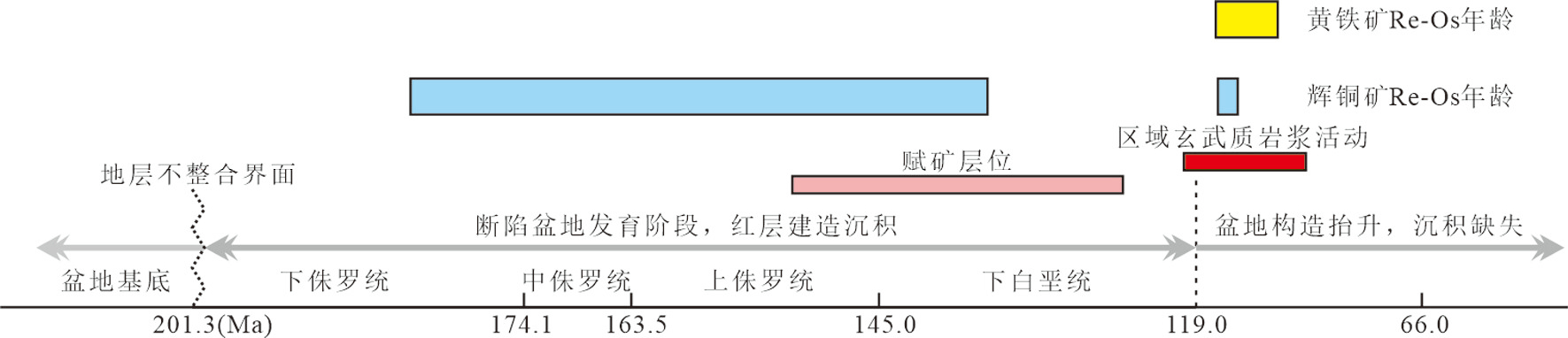
3萨热克铜矿成岩成矿年龄总结
辉铜矿作为陆相 SSC 矿床主要的铜硫化物,其 Re-Os同位素测年目前亦存在较大不确定性。在欧洲 Kupferschiefer 铜矿带和在北美 White Pine 矿床,部分辉铜矿 Re-Os 模式年龄(Alderton et al.,2016Jones et al.,2023)大于赋矿地层时代,其原因被解释为与成矿过程中流体初期氧化作用有关(Jones et al.,2023)。同样情况也出现在中国萨热克矿床(图3),其辉铜矿 Re-Os 模式年龄除最新的年龄 116.4 Ma(贾润幸等,2018)与黄铁矿Re-Os年龄确定的成矿时代(114 Ma,Zhao et al.,2019)在误差范围内相一致外,其余(183.4~136.1 Ma)普遍大于该矿床最新赋矿层位下白垩统的沉积时代(不早于 119 Ma,方维萱,2019)。另外,陆相 SSC 矿床中辉铜矿还存在原生和次生辉铜矿难以区分的问题。
鉴于上述测年方式对于SSC矿床或测试矿物不具有普适性、分选困难或存在较大测试结果不确定性或测试矿物易存在多期多世代、次生/原生的问题,因此需要探索更多测年新技术以约束 SSC 矿床的矿化时代。
SSC 矿床地质特征的总结(Brown,1997Hitzman et al.,2005)表明,碳酸盐化是该类型矿床普遍发育的围岩蚀变类型,其蚀变矿物方解石在 SSC矿床成矿作用各阶段均有广泛分布。近年来方解石原位 U-Pb 测年技术得到快速发展,其原位微区分析方法可有效避免传统单矿物分选困难问题,同时该技术结合激光成像/成图技术在区分不同成因/世代的方解石方面亦具有巨大优势,这为限定 SSC矿床成矿时代提供了新的解决方案。
3 方解石原位 U-Pb 测年技术在矿床学应用现状及展望
LA-ICP-MS方解石定年技术自 Li et al.(2014) 首次用于测定菊石中成岩方解石胶结物的年代并通过 TIMS 法对实验结果进行验证以来,其以低成本、高分辨率、耗时短、制样简单等优点近年来得到快速推广,国内外已有较多关于该技术实验方法和流程、样品制备和处理、尚存关键问题等方面研究进展的综述成果(Roberts et al.,2017Hansman et al.,2018Yokoyama et al.,2018刘恩涛等,2019赵子贤和施炜,2019程婷等,2020Guillong et al., 2020Zhang et al.,2021Nuriel et al.,2021高伊雪等,2022吴石头等,2022张亮亮等,2022谢博航等,2023)。
目前用于方解石U-Pb定年的仪器主要有LA-Q-ICP-MS、LA-SF-ICP-MS 和 LA-MC-ICP-MS,不同设备的差异主要体现在灵敏度和接收器配置上。前两种方式数据处理简单且在测定 U-Pb年龄的同时,还能测定微量元素(Drost al.,2018;Wu et al., 2022),而 LA-MC-ICP-MS 灵敏度最高,其理论上 U 检测限可低至约 0.02×10⁻⁶,并可消除由于 ICP 波动带来的影响(谢博航等,2023)。由于统计的实验室碳酸盐矿物的U、Pb含量数据分别为1.9×10⁻⁶ 和3.0× 10⁻⁹Roberts et al.,2020),因此可满足绝大多数样品。针对多数方解石样品低 U、高普通 Pb 含量,且 U、Pb 元素含量及同位素比值分布不均衡导致的定年成功率较低问题,目前普遍采用点剥蚀、线扫描 (Zhang et al.,2021)或 LA-ICP-MS 二维元素成像辅助U-Pb定年方法(Roberts et al.,2020),识别高U和低普通Pb区域,提高定年精度。
LA-ICP-MS 方解石定年技术极大地拓展了构造脆性变形(Hansman et al.,2018Parrish et al., 2018Yang et al.,2021)、油气运移(Holdsworth et al., 2019Rochelle-Bates et al.,2021)、沉积成岩学 (Drost et al.,2018Montano et al.,2021)、古气候(Ku‐ rumada et al.,2020)等地学领域的年代学发展。同时,该技术在矿床成矿年代学,尤其是长期以来定年存在困难(定年“困难户”)的低温锑矿和汞矿、卡林型金矿、MVT、砂岩型(SST)铅锌矿以及部分岩浆热液型铅锌矿、金矿和砂岩型铀矿等类型矿床的成矿时代方面也取得良好效果。
Luo et al.(2020)对华南低温成矿域维寨锑矿不同成矿阶段的碳酸盐矿物进行 LA-MC-ICP-MS U-Pb 分析,识别出早白垩世(115.3 Ma)和古新世 (60 Ma)两期锑成矿作用,其古新世锑成矿时代与 Xu et al.(2022)通过 LA-MC-ICP-MS 方解石 U-Pb 定年确定的域内锡矿山锑矿古新世早期(58.1 Ma) 锑成矿时代相一致,同时测试结果表明锡矿山锑矿还发育始新世晚期(51.9~50.4 Ma)锑成矿作用,成矿可能与太平洋板块向欧亚板块俯冲(60~40 Ma) 和/或印亚碰撞期间构造-热事件有关。罗开等(2023)对域内尖岩汞矿 LA-MC-ICP-MS 方解石 U-Pb 年代学研究表明,该矿床形成于早古生代末期 (426.3 Ma),属区域上加里东构造作用汞多金属成矿事件的产物。肖昌浩等(2024)对广西丹池成矿带拔旺铁锌锡矿床开展的 LA-SF-ICP-MS 方解石 U-Pb 定年结果表明,该矿床古新世(60 Ma)与盆地卤水有关的锑成矿作用于30 Ma后叠加在早期晚白垩世(90 Ma)与岩浆流体有关的锌锡成矿作用之上。
对于卡林型金矿,Jin et al.(2021)在西南右江盆地水银洞金矿通过 LA/MA-ICP-MS 方解石 U-Pb 分析,识别出晚三叠世(204.3~202.6 Ma)、早侏罗世 (191.9 Ma)和早白垩世(139.3~137.1 Ma)3期金成矿作用。Wang et al.(2023)获得该盆地丫他金矿 LA-ICP-MS 方解石 U-Pb 金成矿时代也为早白垩世 (149~147.3 Ma),表明区域上在早白垩世有一期重要的金成矿事件,可能与古太平洋板块俯冲有关的远程效应有关。Pinet et al.(2022)通过 LA-ICP-MS 方解石 U-Pb 分析,将加拿大 Yukon 地区 Conrad 和 Osiris 金矿成矿时代限定为晚白垩世(75.1~71.2 Ma),表明成矿与区域上含金侵入体相关的成矿事件同时发生。
Sheng et al.(2022)对西南三江成矿带拉诺玛锌铅锑矿床开展的 LA-ICP-MS 方解石 U-Pb 测年表明,该矿床晚期锑铅成矿事件于中新世(19.7 Ma)叠加在早期以锌为主的成矿事件之上。Wang et al. (2022b)在南岭地区大坊金矿进行的 MC-ICP-MS 方解石 U-Pb 测年揭示出金矿化时代(157.7 Ma)与区域上大规模的钨锡成矿(160~150 Ma)同步。 Zhang et al.(2024)对钦杭成矿带康家湾铅锌金矿床进行的LA-ICP-MS方解石U-Pb测年结果表明金成矿作用(151.7 Ma)为区域上晚侏罗世大规模铜-金-铅-锌矿化的重要组成部分。Wang et al.(2024)对东昆仑地区梧桐沟 Ag-Pb-Zn 矿床开展的 LA-ICP-MS方解石 U-Pb测年指示矿床成矿时代下限为 210 Ma,成矿与古特提斯洋后碰撞伸展岩浆热液作用有关。
对于MVT铅锌矿,Giorno et al.(2022)报道了意大利 Gorno 铅锌矿床 LA-ICP-MS 方解石 U-Pb 年龄为晚三叠世(232.2~227 Ma),同期的岩浆活动和盆地伸展构造可能为盆地成矿流体运移提供热源和驱动力。Xiong et al.(2022)通过碳酸盐MC-ICP-MS和重晶石 U-Pb 分析,揭示出扬子板块北缘九岭子铅锌矿经历了早古生代(473.4 Ma)MVT铅锌成矿作用并被泥盆世含 Ba 流体叠加。Zhao et al.(2022)通过对西南天山南缘乌拉根陆相砂岩型铅锌矿床成矿前、成矿期和成矿后方解石开展 LA-SF-ICP-MS 方解石 U-Pb 测年,将矿床成矿时代限定为中新世晚期(11.8~10.6 Ma),成矿与南天山前陆断裂与帕米尔前缘逆冲构造事件同期。同时,该矿床成矿期与方解石共生的黄铁矿 Re-Os 模式年龄为(10.7± 0.1)Ma,与成矿期方解石 U-Pb 年龄(10.9±0.3) Ma 在误差范围相一致,印证了方解石 U-Pb 年龄的准确性。
对于砂岩型铀矿,Yang et al.(2024)对松辽盆地胡力海铀矿进行的LA-ICP-MS白云石U-Pb年龄为60 Ma和40 Ma,揭示出铀矿化作用与古新世构造反转事件和始新世热液事件具有重要的因果联系。
LA-ICP-MS 方解石 U-Pb 测年技术对以上定年“困难户”矿床成矿时代的有效约束,不仅使得我们对各矿床的成因有了更为精确的理解,同时促进了对成矿作用与区域构造-岩浆-流体运移间耦合关系及区域成矿规律的认识,这对当前及未来的矿产勘探也将产生积极的影响。值得注意的是, MVT、SST铅锌矿床、砂岩型铀矿与 SSC矿床均为与盆地卤水有关的矿床类型,而 LA-ICP-MS 方解石 U-Pb测年在前两者的成功运用表明,该技术在解决 SSC 矿床年代学方面亦具有极大的潜力。同时,上述矿床开展LA-ICP-MS方解石定年成功案例表明,详细的野外地质调查和取样配合室内细致的光学显微镜、阴极发光(CL)、背散射图像(BSE)、电镜扫描(SEM)和激光成像等微观鉴定,是方解石U-Pb定年技术成功应用的关键。
4 结论
(1)多种测年技术在 SSC 矿床年代学研究的应用极大地提高了人们对于 SSC 矿床与盆地沉积演化、卤水运移及区域构造运动之间的耦合关系的认识。
(2)目前 SSC 矿床年代学研究还存在测试矿物不具有普适性、测试结果存在较大不确定性、测试矿物易存在多期多世代、次生/原生等问题。
(3)LA-ICP-MS 方解石定年技术对于解决 SSC 矿床成矿年代学问题具有极大的应用前景。
致谢  审稿专家对于本文的修改提出了众多富有建设性的意见,在此表示衷心的感谢!
1全球重要沉积岩型层状铜矿床分布(据Hitzman et al.,2005修改)
2中非铜钴矿带铜钴矿床成矿年龄总结(据Sillitoe et al.,2017Saintilan et al.,2018修改)
3萨热克铜矿成岩成矿年龄总结
Alderton D H, Selby D, Kucha H, Blundell D J. 2016. A multistage ori-gin for Kupferschiefer mineralization[J]. Ore Geology Reviews, 79: 535-543.
Barra F, Broughton D, Ruiz J, Hitzman M. 2004. Multi-stage mineraliza-tion in the Zambian Copperbelt based on Re-Os isotope constraints[C]//Geological Society of America Abstracts with Programs, 36(5): 516.
Bechtel A, Elliott W C, Wampler J M, Oszczepalski S. 1999. Clay miner-alogy, crystallinity, and K-Ar ages of illites within the Polish Zech-stein Basin: Implications for the age of Kupferschiefer mineraliza-tion[J]. Economic Geology, 94(2): 261-272.
Box S E, Syusyura B, Seltmann R, Creaser R A, Dolgopolova A, Zientek M L. 2012. Dzhezkazgan and associated sandstone copper deposits of the Chu-Sarysu Basin, Central Kazakhstan[J]. Society of Eco-nomic Geologists, Special Publication 16: 303-328.
Brown A C. 1997. World class sediment hosted stratiform copper depos-its: Characteristics, genetic concepts and metallotects[J]. Australian Journal of Earth Sciences, 44(3): 317-328.
Cailteux J L H, Kampunzu A B, Lerouge C, Kaputo A K, Milesi J P. 2005. Genesis of sediment-hosted stratiform copper-cobalt depos-its, Central African Copperbelt[J]. Journal of African Earth Sci-ences, 42(1/5): 134-158.
Cahen L, Francois A, Ledent D. 1971. Sur l'âge des uraninites de Kam-bove Ouest et de Kamoto Principal, et révision des connaissances relatives aux minéralisations uranifères du Katanga et du Copper-belt de Zambie[J]. Annales de la Société belge de Géologie, 94: 185-198.
Dewaele S, Muchez P, Vets J, Fernandez-Alonzo M, Tack L. 2006. Mul-tiphase origin of the Cu-Co ore deposits in the western part of the Lufilian fold-and-thrust belt, Katanga (Democratic Republic of Congo)[J]. Journal of African Earth Sciences, 46(5): 455-469.
Drost K, Chew D, Petrus J A, Scholze F, Woodhead J D, Schneider J W, Harper D A. 2018. An image mapping approach to U-Pb LA-ICP-MS carbonate dating and applications to direct dating of carbonate sedimentation[J]. Geochemistry, Geophysics, Geosystems, 19(12): 4631-4648.
Giorno M, Barale L, Bertok C, Frenzel M, Looser N, Guillong M, Ber-nasconi S M, Martire L. 2022. Sulfide-associated hydrothermal do-lomite and calcite reveal a shallow burial depth for Alpine-type Zn-(Pb) deposits[J]. Geology, 50(7): 853-858.
Guillong M, Wotzlaw J F, Looser N, Laurent O. 2020. Evaluating the reli-ability of U-Pb laser ablation inductively coupled plasma mass spectrometry (LA-ICP-MS) carbonate geochronology: matrix issues and a potential calcite validation reference material[J]. Geochronol-ogy, 2(1): 155-167.
Hansman R J, Albert R, Gerdes A, Ring U. 2018. Absolute ages of mul-tiple generations of brittle structures by U-Pb dating of calcite[J]. Geology, 46(3): 207-210.
Hitzman M, Kirkham R, Broughton D, Thorson J, Selley D. 2005. The sediment-hosted stratiform copper ore system[J]. Economic Geol-ogy, 100: 609-642.
Hitzman M W, Selley D, Bull S. 2010. Formation of sedimentary rock-hosted stratiform copper deposits through Earth history[J]. Eco-nomic Geology, 105(3): 627-639.
Hitzman M W, Broughton D, Selley D, Woodhead J, Wood D, Bull S. 2012. The Central African Copperbelt: Diverse stratigraphic, struc-tural, and temporal settings in the world's largest sedimentary cop-per district[J]. Society of Economic Geologists, Special Publication, 16: 487-514.
Holdsworth R E, McCaffrey K J W, Dempsey E, Roberts N M W, Hard-man K, Morton A, Feely M, Hunt J, Conway A, Robertson A. 2019. Natural fracture propping and earthquake-induced oil migration in fractured basement reservoirs[J]. Geology, 47(8): 700-704.
Huang X W, Zhao X F, Qi L, Zhou M F. 2013. Re, Os and S isotopic con-straints on the origins of two mineralization events at the Tangdan sedimentary rock-hosted stratiform Cu deposit, SW China[J]. Chemical Geology, 347: 9-19.
Jin X Y, Zhao J X, Feng Y X, Hofstra A H, Deng X D, Zhao X F, Li J W. 2021. Calcite U-Pb dating unravels the age and hydrothermal his-tory of the giant Shuiyindong Carlin-type gold deposit in the golden triangle, South China[J]. Economic Geology, 116(6): 1253-1265.
John T, Schenk V, Mezger K, Tembo F. 2004. Timing and PT evolution of Whiteschist metamorphism in the Lufilian Arc-Zambezi Belt oro-gen (Zambia): Implications for the assembly of Gondwana[J]. The Journal of geology, 112(1): 71-90.
Jones S M, Cloutier J, Prave A R, Raub T D, Stüeken E E, Stein H J, Yang G, Boyce A J. 2023. Fluid flow, alteration, and timing of CuAg Mineralization at the White Pine Sediment-Hosted Copper De-posit, Michigan, USA[J]. Economic Geology, 118(6): 1431-1465.
Jowett E C. 1987. Formation of sulfide-calcite veinlets in the Kupfer-schiefer Cu-Ag deposits in Poland by natural hydrofracturing dur-ing basin subsidence[J]. The Journal of Geology, 95(4): 513-526.
Kucha H, Przylowicz W. 1999. Noble metals in organic matter and clay-organic matrices, Kupferschiefer, Poland[J]. Economic Geology, 94 (7): 1137-1162.
Kurumada Y, Aoki S, Aoki K, Kato D, Saneyoshi M, Tsogtbaatar K, Windley B F, Ishigaki S. 2020. Calcite U-Pb age of the Cretaceous vertebrate-bearing Bayn Shire Formation in the Eastern Gobi Des-ert of Mongolia: Usefulness of caliche for age determination[J]. Terra Nova, 32(4): 246-252.
Li Q, Parrish R R, Horstwood M S A, McArthur J M. 2014. U-Pb dating of cements in Mesozoic ammonites[J]. Chemical Geology, 376: 76-83.
Luo K, Zhou J X, Feng Y X, Uysal I T, Nguyen A, Zhao J X, Zhang J. 2020. In situ U-Pb dating of calcite from the South China antimony metallogenic belt[J]. Iscience, 23(10): 101575.
Meneghel L. 1981. The occurrence of uranium in the Katanga system of northwestern Zambia[J]. Economic Geology, 76: 56-68.
Milton J E, Hickey K A, Gleeson S A, Falck H, Allaz J. 2017. In situ monazite dating of sediment-hosted stratiform copper mineraliza-tion in the Redstone Copper belt, Northwest Territories, Canada: Cupriferous fluid flow late in the evolution of a Neoproterozoic sedi-mentary basin[J]. Economic Geology, 112(7): 1773-1806.
Montano D, Gasparrini M, Gerdes A, Della Porta G, Albert R. 2021. In-situ U-Pb dating of Ries Crater lacustrine carbonates (Miocene, South-West Germany): Implications for continental carbonate chro-nostratigraphy[J]. Earth and Planetary Science Letters, 568: 117011.
Muchez P, André-Mayer A S, El Desouky H A, Reisberg L. 2015. Diage-netic origin of the stratiform Cu-Co deposit at Kamoto in the Cen-tral African Copperbelt[J]. Mineralium Deposita, 50: 437-447.
Nawrocki J. 1997. Permian to Early Triassic magnetostratigraphy from the Central European Basin in Poland: Implications on regional and worldwide correlations[J]. Earth and Planetary Science Letters, 152 (1/4): 37-58.
Nuriel P, Wotzlaw J F, Ovtcharova M, Vaks A, Stremtan C, Šala M, Rob-erts N M W, Kylander-Clark A R. 2021. The use of ASH-15 flow-stone as a matrix-matched reference material for laser-ablation U-Pb geochronology of calcite[J]. Geochronology, 3: 35-47.
Parrish R R, Parrish C M, Lasalle S. 2018. Vein calcite dating reveals Pyrenean orogen as cause of Paleogene deformation in southern England[J]. Journal of the Geological Society, 175(3): 425-442.
Pašava J, Oszczepalski S, Du A D. 2010. Re-Os age of non-mineralized black shale from the Kupferschiefer, Poland, and implications for metal enrichment[J]. Mineralium Deposita, 45: 189-199.
Perelló J, Clifford J A, Creaser R A, Valencia V A. 2015. An example of synorogenic sediment-hosted copper mineralization: Geologic and geochronologic evidence from the Paleoproterozoic Nussir deposit, Finnmark, Arctic Norway[J]. Economic Geology, 110(3): 677-689.
Perelló J, Sillitoe R H, Yakubchuk A S, Valencia V A, Cornejo P. 2017. Age and tectonic setting of the Udokan sediment-hosted copper-silver deposit, Transbaikalia, Russia[J]. Ore Geology Reviews, 86: 856-866.
Perelló J, Valencia V A, Cornejo P, Clifford J, Wilson A J, Collins G. 2019. Timing of sediment-hosted Cu-Ag mineralization in the Trans-Hudson orogen at Janice Lake, Wollaston Domain, Saskatch-ewan, Canada[J]. Mineralium Deposita, 54(1): 81-100.
Perelló J, Clifford J A, Wilson A J, Kennedy S, Creaser R A, Valencia V A. 2021. On the timing and metallogenic implications of the sediment-hosted stratiform copper-silver mineralization in the Creston Formation (Belt-Purcell Supergroup), British Columbia, Canada[J]. Ore Geology Reviews, 131: 104032.
Perelló J, Wilson A, Wilton J, Creaser R A. 2022. Lufilian copper-gold mineralization in the Mkushi District, Zambia: regional metallo-genic implications[J]. Mineralium Deposita, 57(7): 1089-1106.
Pinet N, Davis W J, Petts D C, Sack P, Mercier-Langevin P, Lavoie D, Jackson S E. 2022. U-Pb vein calcite dating reveals the age of Carlin-type gold deposits of central Yukon and a contemporaneity with a regional intrusion-related metallogenic event[J]. Economic Geology, 117(4): 905-922.
Qiu Z J, Fan H R, Liu X, Yang K F, Hu F F, Xu W G, Wen B J. 2016. Mineralogy, chalcopyrite Re-Os geochronology and sulfur isotope of the Hujiayu Cu deposit in the Zhongtiao Mountains, North China Craton: Implications for a Paleoproterozoic metamorphogenic cop-per mineralization[J]. Ore Geology Reviews, 78: 252-267.
Richards J P, Cumming G L, Krstic D, Wagner P A, Spooner E T C. 1988a. Pb isotope constraints on the age of sulfide ore deposition and U-Pb age of late uraninite veining at the Musoshi stratiform copper deposit, Central Africa copper belt, Zaire[J]. Economic Geol-ogy, 83(4): 724-741.
Richards J P, Krogh T E, Spooner E T C. 1988b. Fluid inclusion charac-teristics and U-Pb rutile age of late hydrothermal alteration and veining at the Musoshi stratiform copper deposit, Central African Copper Belt, Zaire[J]. Economic Geology, 83(1): 118-139.
Rochelle-Bates N, Roberts N M W, Sharp I, Freitag U, Verwer K, Hal-ton A, Fiordalisi E, Van Dongen B E, Swart R, Ferreira C H, Dixon R, Schröder S. 2021. Geochronology of volcanically associated hy-drocarbon charge in the pre-salt carbonates of the Namibe Basin, Angola[J]. Geology, 49: 335-340.
Roberts N M, Rasbury E T, Parrish R R, Smith C J, Horstwood M S, Con-don D J. 2017. A calcite reference material for LA-ICP-MS U-Pb geochronology[J]. Geochemistry, Geophysics, Geosystems, 18(7): 2807-2814.
Roberts N M W, Drost K, Horstwood M S A, Condon D J, Chew D, Drake H, Milodowski A E, McLean N M, Smye A J, Walker R J, Haslam R, Hodson K, Imber J, Beaudoin N, Lee J K. 2020. Laser ablation inductively coupled plasma mass spectrometry (LA-ICPMS) U-Pb carbonate geochronology: Strategies, progress, and limitations[J]. Geochronology, 2: 33-61.
Saintilan N J, Selby D, Creaser R A, Dewaele S. 2018. Sulphide Re-Os geochronology links orogenesis, salt and Cu-Co ores in the Central African Copperbelt[J]. Scientific Reports, 8(1): 14946.
Schneider J, Melcher F, Brauns M. 2007. Concordant ages for the giant Kipushi base metal deposit (DR Congo) from direct Rb-Sr and Re-Os dating of sulfides[J]. Mineralium Deposita, 42: 791-797.
Selley D, Broughton D, Scott R, Hitzman M, Bull S, Large R, McGold-rick P, Croaker M, Pollington N, Barra F. 2005. A new look at the geology of the Zambian Copperbelt[J]. Economic Geology, 100: 965-1000.
Selby D, Creaser R A, Stein H J, Markey R J, Hannah J L. 2007. Assess-ment of the 187Re decay constant by cross calibration of Re-Os mo-lybdenite and U-Pb zircon chronometers in magmatic ore systems[J]. Geochimica et Cosmochimica Acta, 71(8): 1999-2013.
Selby D, Kelley K D, Hitzman M W, Zieg J. 2009. Re-Os sulfide (born-ite, chalcopyrite, and pyrite) systematics of the carbonate-hosted copper deposits at Ruby Creek, southern Brooks Range, Alaska[J]. Economic Geology, 104(3): 437-444.
Sheng X, Tang Y, Bi X, Hu R, Xu L, Li J, Tang Y. 2022. In situ U-Pb dating of calcite indicates a Miocene Sb-Pb mineralization event in the Sanjiang base metal metallogenic belt, SW China[J]. Journal of Geochemical Exploration, 238: 107004.
Singer D A. 1995. World class base and precious metal deposits: A quantitative analysis[J]. Economic Geology, 90(1): 88-104.
Sillitoe R H, Perelló J, García A. 2010. Sulfide-bearing veinlets through-out the stratiform mineralization of the Central African Copperbelt: temporal and genetic implications[J]. Economic Geology, 105(8): 1361-1368.
Sillitoe R H, Perelló J, Creaser R A, Wilton J, Dawborn T. 2015. Two ages of copper mineralization in the Mwombezhi dome, northwest-ern Zambia: Metallogenic implications for the Central African Cop-perbelt[J]. Economic Geology, 110(8): 1917-1923.
Sillitoe R H, Perelló J, Creaser R A, Wilton J, Wilson A J, Dawborn T. 2017. Age of the Zambian Copperbelt[J]. Mineralium Deposita, 52 (8): 1245-1268.
Słowakiewicz M, Kiersnowski H, Wagner R. 2009. Correlation of the Middle and Upper Permian marine and terrestrial sedimentary se-quences in Polish, German, and USA Western Interior Basins with reference to global time markers[J]. Palaeoworld, 18(2/3): 193-211.
Stein H J, Markey R J, Morgan J W, Hannah J L, Scherstén A. 2001. The remarkable Re-Os chronometer in molybdenite: how and why it works[J]. Terra Nova, 13(6): 479-486.
Steven N, Armstrong R. 2003. A metamorphosed Proterozoic carbona-ceous shale-hosted Co-Ni-Cu deposit at Kalumbila, Kabompo Dome: The Copperbelt ore shale in northwestern Zambia[J]. Eco-nomic Geology, 98(5): 893-909.
Sweeney M, Turner P, Vaughan D J. 1986. Stable isotope and geochemi-cal studies in the role of early diagenesis in ore formation, Konkola Basin, Zambian copper belt[J]. Economic Geology, 81(8): 1838-1852.
Symons D T, Kawasaki K, Walther S, Borg G. 2011. Paleomagnetism of the Cu-Zn-Pb bearing Kupferschiefer black shale (Upper Permian) at Sangerhausen, Germany[J]. Mineralium Deposita, 46: 137-152.
Torsvik T H, Van der Voo R, Meert J G, Mosar J, Walderhaug H J. 2001. Reconstructions of the continents around the North Atlantic at about the 60th parallel[J]. Earth and Planetary Science Letters, 187 (1/2): 55-69.
Torrealday H I, Hitzman M W, Stein H J, Markley R J, Armstrong R, Broughton D. 2000. Re-Os and U-Pb dating of the vein-hosted mineralization at the Kansanshi copper deposit, northern Zambia[J]. Economic Geology, 95(5): 1165-1170.
Waizy H, Moles N R, Smith M P, Boyce A J. 2021. Formation of the gi-ant Aynak copper deposit, Afghanistan: Evidence from mineralogy, lithogeochemistry and sulphur isotopes[J]. International Geology Review, 63(17): 2104-2128.
Wang M, Mao J, Ye H, Li H. 2022a. The Age of Hubi Copper (Cobalt) Ore Mineralization in the Zhongtiao Mountain Area, Southern Mar-gin of the Trans-North China Orogen: New Constraints from U-Pb Dating of Rutile and Monazite[J]. Minerals, 12(3): 288.
Wang K, Zhai D, Zhang L, Li C, Liu J, Wu H. 2022b. Calcite U-Pb, py-rite Re-Os geochronological and fluid inclusion and H-O isotope studies of the Dafang gold deposit, South China[J]. Ore Geology Re-views, 150: 105183.
Wang R, Wang Q, Zhao J X, Groves D I, Kirkland C L, Feng Y X, Uysal I T, Yang L, Deng J. 2023. Carbonate U-Pb and illite Rb-Sr geo-chronology of sediment-hosted gold: A case study of Yata gold de-posit[J]. Chemical Geology, 621: 121352.
Wang S, Li W, Zhao X, Huizenga J, Zhang X, Xu C, Yu S, Li Y, Wei J. 2024. Genesis of the Wutuogou Ag-Pb-Zn deposit in the Eastern Kunlun Orogenic Belt, NW China: Constraints from calcite U-Pb geochronology, mineral chemistry, and in-situ sulfur isotopes[J]. Ore Geology Reviews, 165: 105880.
Wu S, Yang Y, Roberts N M, Yang M, Wang H, Lan Z, Xie B, Li T, Huang C, Xie L, Yang J, Wu F. 2022. In situ calcite U-Pb geochro-nology by high-sensitivity single-collector LA-SF-ICP-MS[J]. Sci-ence China Earth Sciences, 65(6): 1146-1160.
Xiong S F, Jiang S Y, Chen Z H, Zhao J X, Ma Y, Zhang D, Duan Z, Niu P, Xu Y M. 2022. A Mississippi Valley-type Zn-Pb mineralizing system in South China constrained by in situ U-Pb dating of car-bonates and barite and in situ S-Sr-Pb isotopes[J]. GSA Bulletin, 134(11/12): 2880-2890.
Xu J, Liu X, Lai J, He H, Song X, Zhai D, Li B, Wang Y, Shi J, Zhou X. 2022. In situ U-Pb geochronology of calcite from the world’s larg-est antimony deposit at Xikuangshan, southern China[J]. Minerals, 12(7): 899.
Yang D G, Nie F J, Xia F, Zhang L L, Tang Y W, Yang Z B, Yang Z F, Wang F M. 2024. In situ U-Pb dating of dolomite: Reliable ages for sandstone-hosted uranium deposits in the southern Songliao Basin, NE China[J]. Ore Geology Reviews, 174: 106331.
Yang P, Wu G, Nuriel P, Nguyen A D, Chen Y, Yang S, Feng Y, Ren Z, Zhao J X. 2021. In situ LA-ICP-MS U-Pb dating and geochemical characterization of fault-zone calcite in the central Tarim Basin, northwest China: Implications for fluid circulation and fault reacti-vation[J]. Chemical Geology, 568: 120125.
Yokoyama T, Kimura J I, Mitsuguchi T, Danhara T, Hirata T, Sakata S, Iwane H, Maruyama S, Chang Q, Miyazaki T, Murakami H, Saito-Kokubu Y. 2018. U-Pb dating of calcite using LA-ICP-MS: Instru-mental setup for non-matrix-matched age dating and determina-tion of analytical areas using elemental imaging[J]. Geochemical Journal, 52(6): 531-540.
Zhang L L, Zhu D C, Yang Y H, Wang Q, Xie J C, Zhao Z D. 2021. U-Pb geochronology of carbonate by laser ablation MC-ICP-MS: Method improvements and geological applications[J]. Atomic Spec-troscopy, 42(6): 335-348.
Zhang L X, Song Y L, Hou K J, Zhao P L, Yuan S D. 2024. Genetic link between the Kangjiawan gold deposit and late Jurassic granitic mag-matism, South China: Constraints from in situ calcite U-Pb dating, sulfur isotope and trace elements of pyrite[J]. Ore Geology Reviews, 171: 106191.
Zhang Y, Zhou S, Wu X, Hu Q. 2023. Genesis of the Samba Cu deposit of the Central African Copperbelt in Zambia: Constraints from geo-chemistry and geochronology[J]. Geological Society of America Bul-letin, 16: 303-328.
Zhao X F, Zhou M F, Li J W, Qi L. 2013. Late Paleoproterozoic sedimen-tary rock-hosted stratiform copper deposits in South China: Their possible link to the supercontinent cycle[J]. Mineralium Deposita, 48: 129-136.
Zhao L T, Wang J B, Wang Y W, Zhu X Y, Li C. 2019. Pyrite Re-Os geochronology of the Sareke sediment-hosted Cu deposit, Xinjiang, NW China[J]. Ore Geology Reviews, 104: 620-627.
Zhao L T, Zhou G C, Gao R Z, Tang Y W. 2022. Application of calcite U-Pb geochronology in sandstone-hosted Pb-Zn deposits: A case study of the giant Uragen deposit, NW China[J]. Journal of Asian Earth Sciences, 237: 105371.
程婷, Zhao J X, Feng Y X, 潘文庆, 刘敦一. 2020. 低铀碳酸盐矿物的 LA-MC-ICPMS 微区原位 U-Pb 定年方法[J]. 科学通报, 65(2/3): 150-154.
方维萱. 2019. 岩浆侵入构造系统 Ⅰ: 构造岩相学填图技术研发与找矿预测效果[J]. 大地构造与成矿学, 43(3): 473-506.
冯雨周, 邵拥军, 葛超, 蒋梦同, 宋泽友. 2017. 湖南衡阳柏坊铜矿床地质特征及成因分析[J]. 南方金属, 215(2): 29-31.
高伊雪, 邱昆峰, 于皓丞, 侯照亮, 魏瑜吉. 2022. 碳酸盐矿物激光原位U-Pb定年基本原理, 分析方法与地学应用[J]. 岩石矿物学杂志, 41(4): 786-803.
黄崇柯, 白冶, 朱裕生, 王惠章, 尚修治. 2001. 中国铜矿床[M]. 北京: 地质出版社, 1-705.
韩润生, 邹海俊, 吴鹏, 方维萱, 胡煜昭. 2010. 楚雄盆地砂岩型铜矿床构造-流体耦合成矿模型[J]. 地质学报, 84(10): 1438-1447.
贾润幸, 方维萱, 李建旭, 陈腾, 李述国. 2018. 新疆萨热克铜矿床铼-锇同位素年龄及其地质意义[J]. 矿床地质, 37(1): 151-162.
刘恩涛, 潘松圻, 严德天, 陆江, 郝少斌, 龚银, 邹康. 2019. 盆地流体年代学研究新技术: 方解石激光原位 U-Pb 定年法[J]. 地球科学, 44(3): 698-712.
李金春. 2009. 北祁连天鹿铜矿床砂岩型铜矿石特征[J]. 矿床地质, 28(4): 473-480.
罗开, 周家喜, Alexandre C, 周美夫, 俸月星, 金中国, Zhao J X. 2023. 华南古生代汞成矿事件: 黔东尖岩汞矿方解石原位 U-Pb 年代学及地球化学约束[J]. 中国科学: 地球科学, 53(8): 1898-1912.
罗卫, 孙宁, 魏红军. 2015. 沅麻盆地砂岩型铜矿成矿地质特征及其控矿条件研究[J]. 中国矿业, 24(9): 72-79.
孙胜玲, 李杰, 许继峰, 王桂琴. 2022. 金属硫化物Re-Os同位素定年技术进展[J]. 岩石学报, 38(6): 1605-1620.
汤钰御, 刘高杰, 陈向平, 谢建平, 王鹏飞, 王纪昆, 王建青, 冀建军. 2024. 中非铜矿带恩古巴群铜多金属矿床地质特征与找矿潜力[J]. 矿产勘查, 15(8): 1445-1455.
王幻, 曾瑞垠, 何海洋, 王新雨, 张志超, 闫鹏程, 郭建栋, 范姣. 2023. 中非铜(钴)成矿带构造地质特征及其控矿作用研究[J]. 矿产勘查, 14(11): 2125-2134.
吴石头, 杨岳衡, Roberts N M W, 杨明, 王浩, 兰中伍, 谢博航, 李天义, 许蕾, 黄超, 谢烈文, 杨进辉, 吴福元. 2022. 高灵敏度-单接收杯 LA-SF-ICP-MS 原位方解石 U-Pb 定年[J]. 科学通报, 52 (7): 1375-1390.
肖昌浩, 韦昌山, 张宇, 陈正乐, 乐兴文, 余树青. 2024. 广西丹池成矿带拔旺铁锌锡矿床方解石 U-Pb 定年和微区 XRF 面扫描[J]. 地球科学, 49(12): 4335-4350.
谢博航, 吴石头, 杨岳衡, 王浩, 赵子福, 黄超, 谢烈文. 2023. LA-MC-ICP-MS 方解石 U-Pb 定年技术[J]. 岩石学报, 39(1): 236-248.
杨忠芳, 文海霞, 曹华文. 2011. 四川会理大铜矿铜矿床成因及成矿模式探讨[J]. 现代矿业, 1(1): 54-57.
张亮, 李碧乐, 张晗, 胡安新. 2013. 山西中条山桐木沟铜矿床辉钼矿的铼-锇测年及地质意义[J]. 世界地质, 32(4): 740-746.
张亮亮, 朱弟成, 谢锦程, 王青, 鲁瑶, 徐若炎, 齐宁远. 2022. 碳酸盐矿物激光原位U-Pb定年: 进展与展望[J]. 矿物岩石地球化学通报, 41(6): 1120-1134.
赵子贤, 施炜. 2019. 方解石 LA-(MC-) ICP-MS U-Pb 定年技术及其在脆性构造中的应用[J]. 地球科学与环境学报, 41(5): 505-516.
祝新友, 王京彬. 2014. 新疆塔西南地区与盆地卤水作用有关的金属矿床成矿系统[J]. 矿产勘查, 5(2): 136-148.